As Malaysia prepares for the cascading impacts of El Niño, the immediate reflex for site leadership — Project Managers, Procurement Heads, and Managing Directors — is to address the logistical threats: water scarcity, workforce health, and equipment failure. However, treating El Niño as purely a physical weather event is a critical oversight. In the construction and Oil & Gas (O&G) sectors, climate volatility is effectively a financial volatility event.
The true challenge isn't just surviving the weather; it is preventing the "hidden leakage" that occurs when emergency operations bypass standard financial controls.
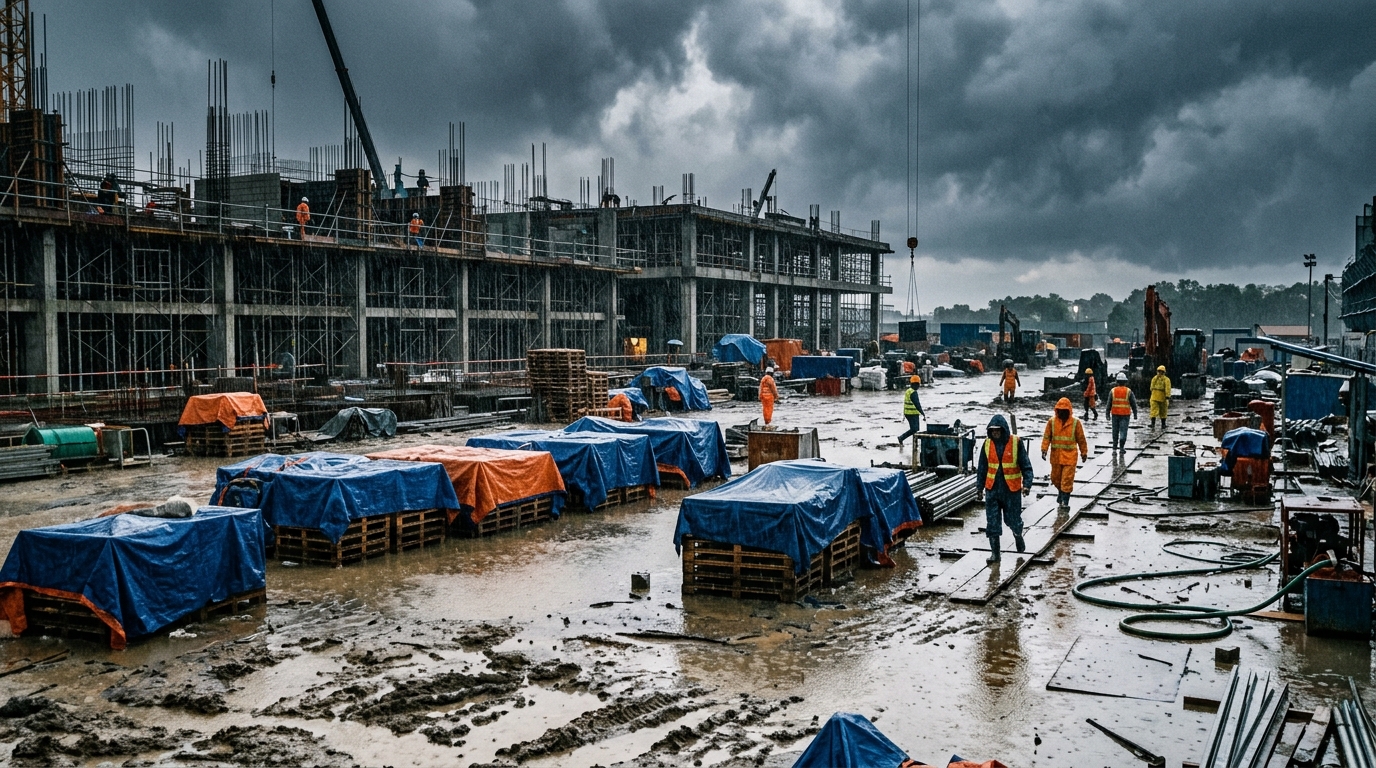
The Operational Pivot: Productivity Under Pressure
Extreme heat is fundamentally forcing a restructuring of the industrial "day." Across Peninsular Malaysia, Sabah, and Sarawak, we are observing a necessary migration away from standard working hours toward evening shifts to preserve equipment integrity and worker safety.
This operational shift creates distinct impacts:
- Building Construction: This sector faces the highest risk. Rural sites, already strained by water supply issues, face a quality-control crisis. High-quality concrete requires neutral-pH water; utilizing contaminated or acidic water sources during a drought risks structural integrity, leading to inspection delays and rework.
- Earthworks & Civil Engineering: While drier soil conditions may temporarily boost Field Density Test (FDT) performance and excavation speeds, this gain is often offset by the rapid breakdown of heavy machinery struggling with sustained heat exposure.
The Silent Threat: Financial Leakage in "Emergency Mode"
The biggest threat to project margins isn't the heat itself — it's the breakdown of financial discipline that happens when teams shift into "emergency mode." When a vital pump overheats at 2:00 AM or a critical drill fails, the standard three-day procurement cycle breaks down. This is where companies lose control.
The "Emergency Spend" Trap:
| Risk Factor | Impact on Margin |
|---|---|
| Unmonitored Petty Cash | When site teams scramble for parts, they rely on ad-hoc petty cash. Without instant visibility, this "cash on the ground" is rarely audited until it's too late. |
| Premium Pricing | Emergency sourcing removes the time for comparative quoting, leading to inflated prices that erode tight margins. |
| Compliance Exposure | Trying to retroactively process digital records for LHDN e-Invoice compliance while managing an active crisis creates a high risk of audit failure. |
In low-margin environments, these fragmented, unmonitored expenditures compound rapidly. Resilience is not just having backup generators on site; it is ensuring your financial workflows match the speed and unpredictability of your field operations.
If your project is resilient on the ground but leaking cash in the office, it is not actually resilient. Industrial teams must treat Financial Agility as a core competency during El Niño.
True operational resilience requires a framework that integrates: Transparent Tracking, Streamlined Routing, Audit Readiness.
El Niño will continue to test the endurance of Malaysian industrial sites. While site managers focus on the physical variables—the water, the machines, and the heat—Project Directors must focus on the financial variables. Protect your margins by institutionalizing financial agility. When the temperature climbs, your ability to track every ringgit is the only thing standing between an operational adaptation and a financial disaster.
Industry Note: Platforms like Bilaro were designed specifically to bridge this gap for Malaysian industrial teams so your team can focus on keeping sites running, no matter how high the temperature climbs.